I casi della vita

Cernavoda: acqua nera. Già avamposto romano, poi tristemente famosa per il canale della morte, fino a Costanza. Uno dei tanti, fatto scavare da Ceausescu per risparmiare i 300 km di Danubio che sale a nord per poi deviare a sud est verso il Mar Nero. Cernavoda-Cernobyl stessa radice nera. Anche a Cernavoda c’è una centrale nucleare.

Con tutta questa energia ci mancava il nucleare?

Al bar bollente ci sono una cameriera pelosa e uomini che mostrano con orgoglio la pancia: un luogo talmente brutto da far quasi tenerezza. Solo i cani randagi portano un po’ di grazia in questo piazzale assolato e di cemento polveroso con tamarri che accelerano e frenano rumorosamente. Dei gusti non conviene discutere. Io ho i miei e loro i loro. Non li giudico ma questo posto mi fa davvero cagare.

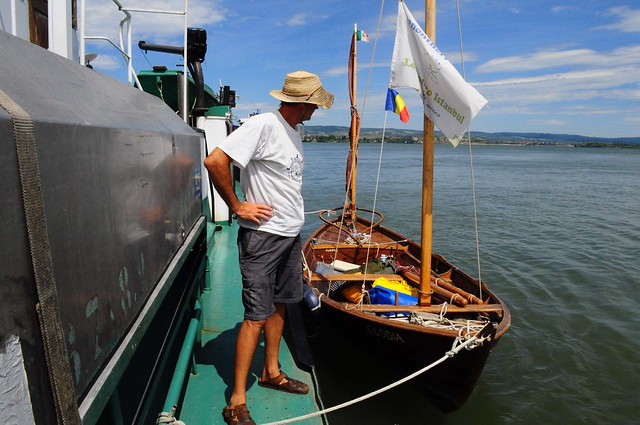
Spero solo di andarmene al più presto. E pensare che un gentile signore ci indica dove ormeggiare, e un altrettanto gentile signore, Rado, un vichingo che ha scelto questo non-luogo per vivere su una chiatta, ci concede di ormeggiare la barca.

Ma che ci faccio io qui? Primo c’è qui sotto il Danubio e qui ci sono arrivato tra colpi di remi, vento e per ultimo il passaggio dal capitano Florian. A proposito ho, abbiamo fatto 4200 km da Wargrave, nell’aprile 2010. (more…)


A matter of chance

Cernavoda: Black water. A former Roman outpost, has become sadly famous for the death channel digged from here to Constanta. One of the many channels built upon order of Ceausescu, to cut 300 km of Danube that turns north before bending east again in Black Sea. Cernavoda – Chernobyl, same black root. Also in Cernavoda there is a nuclear plant.

With all that energy did they need nuclear power too?

In a boiling hot bar, I see a hairy waitress and many men proudly showing their belly: A place so ugly that’s nearly touching. Only the stray dogs bring some gentleness in this sunny square, full of gross people who loudly accelerate and brake. I don’t judge anyone but this place is horrible.

I just hope to get away as soon as possible. However a very kind gentleman has told us where we could moor and another one, Rado (a Viking who’s chosen this no-place to live on a barge), allows us to stay.

But what am i doing here? First of all, the Danube is flowing under me: I’ve arrived here by rowing, sailing and, last but not least, a lift from Captain Florian. By the way we’ve covered 4.200 km from Wargrave, UK, in April 2010.

And here, shortly, I’ll be joined by Nicola and Tommaso. In the four and a half hour waiting, I watch the barges manoeuvreing, the oldest Danube’s iron bridge (1895), the hairs of the hairy woman and the bellies of the big-bellied men. (more…)


A bordo del Leviatano

Dopo una notte animata da teppistelli che gettavano pietre alle barche e si muovevano sospetti, ci mettiamo in movimento per una passeggiata mattutina a Kladovo. Scopro un museo archeologico piccolo ma ricco di pietre importanti che raccontano la strada Traianea che qui, tra Kladovo e Dobreta, vide il più lungo ponte della storia per molto molto tempo, costruito nientepopodimeno che da Apollodoro di Damasco uno dei primi archistar della storia. Chissà se i nostri archistar rimarranno a brillare nella storia fulgidi come lui.

Alla polizia si va via lisci grazie a Miletin che conosce tutti. Lo abbraccio e via nella Dunav che dopo poche decine di metri, voilà, diventa Dunarea. Siamo in Romania. Entriamo a Dobreta Turnu Severn, tre nomi per un luogo solo.

Espletiamo formalità come se entrassimo in altro paese extracomunitario ma ci dicono cortesissimi poliziotti che è perché proveniamo dalla fuori UE. Uno di questi giorni morirò per un eccesso di risa (come diceva Bernard Motessier, anche lui allergico ai confini degli uomini).

Costel, un tipo simpatico che si occupa delle grandi navi che attraccano, ci fa stare all’ormeggio della sua chiatta galleggiante. Si rivelerà vitale. Con Mario, giovane e gentilissimo poliziotto, andiamo insieme in centro. E mangiamo una pizza italorumena al Cafe Barcelona, alla faccia del cibo locale che cerco di mangiare. Adoro la pizza. Vivrei di sola pizza.

Mario mi racconta della vita di qui. Lui ha lavorato ad Orvieto ed è tornato. Si guadagna meno ma si sta meglio qui. Vorrei dormire ma si rannuvola. Viene giù una tempesta coi fiocchi. La sento e mi rifugio sulla chiatta. Costel mi vede e mi invita ad entrare. Mi metto a dormire su un divano e dopo pochissimo, con raffiche che di sicuro arrivano a 40 nodi, onde e fulmini full screen, arrivano dentro anche Anna e Leon.

(more…)


Aboard the Leviathan

We get moving for a walk around Kladovo, after a disturbed night because of a few hooligans who had fun by throwing rocks to the boats. I discover an archaeology museum, small but rich of important stones, telling the story of the Traianea road that here, between Kladovo and Dobreta, displayed the longest bridge in history for a long time. It was designed by no less than Apollodorus of Damascus, one of the first Archistars. I wonder if some of nowadays archistars will shine in history for as long as him.

At the police station everything goes well because of Miletin who knows everyone. I hug him and set off in the Dunav that, after a few metres, becomes Dunarea. We’re in Romania as we approach Dobreta Turnu Severin, three names for just one city.

We have tu fullfill entrance forms as if we were accessing another extra UE country, but the police very kindly tells us that this is the procedure if you come from Serbia. One of these days I’ll die by laughs (as said by Bernard Motessier who was allergic like me to human borders).

Costel, a nice guy who takes care of big ships docking, allow us to moor next to his barge. It’ll be vital. Along with Mario, young policeman, we get to the city center and eat an Italian-Romanian pizza at Café Barcelona. In the teeth of local food that I try to eat as much as I can. I love pizza, I’d live by pizza.

Mario tells me about life here. He’s worked in Orvieto but came back. Here, the wages are lower but the life quality much better. I’d take a sleep but it gets cloudy: A thunderstorm is falling upon us, so I take shelter in the barge. Costell sees me and asks me to get in. I sleep a while over a sofa, then Anna end Leon make their appearance too. Outside, wind gusts of 40 knots, full-screen waves and thunderbolts. (more…)


Il vento della follia

Sono rimasto a Golubac, con Anna e Leon, per sette giorni. Sono stati sette giorni di vento e di bellezza. Golubac è un piccolo paradiso.

Piccolo paese, circa 2.000 abitanti, ed il Danubio che si allarga fino a formare un lago largo quasi 7 km e lungo 10. Questo è il risultato della costruzione della chiusa Derdap, o Portile de Fier o Iron Gate o Eiser Tor. In italiano, “Porte di ferro”. Una volta qui il fiume era davvero duro: rocce, corrente folle e paura. Ora non più

Quando chiudi una gola l’acqua sale e così con 32 metri d’acqua in più si forma questo lago. Certo non è buono per l’ecosistema, ma siccome non tutto il male viene per nuocere ecco che la navigazione si semplifica. Si crea energia e i velisti arrivano.

Qui ne incontriamo di straordinari, come 5 ragazzini della squadra nazionale serba di classe Optimist, forse la barca a vela più semplice e geniale della storia. Questi campioncini mi fanno sentire un incapace. Per ben tre volte tento di passare la strettoia del castello dove la Koshava aumenta fino a 30 nodi (circa 60 km/h) e le onde che crea contro la corrente sono esattamente quelle che Clodia teme di più. Corte e ripide. (more…)


The wind of madness

We stayed in Golubac for seven days. They’ve been days of wind and beauty. Golubac is a little paradise.

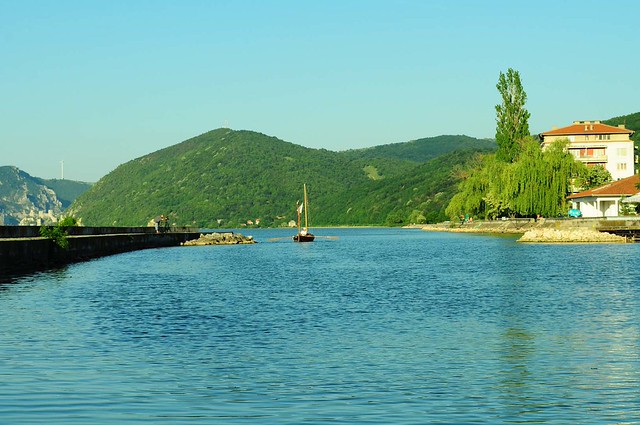
Small town, about 2.000 people, and the Danube that spreads wide to shape a 7 by 10 km lake. This is the result of the building of Derdap lock, also called Portile de Fier, Eiser Tor, Porte di Ferro. In english “Iron Gates”. Once the river here was really tough: Rocks, strong current and fear. But not anymore.

When you lock a gorge, the water rises, so the 32 metres of extra water created this lake. It’s not good for the ecosystem, however it bears some positive aspects, such as the generation of energy and a much nicer navigation attracting sailors.

Here we meet some extraordinary ones, as the 5 kids from the Serbian national team Optimist class, probably the simplest and smarter sailboat in history. Thos guys make me feel a dummy. For three times I try to pass the bottleneck under the castle, where the Koshava wind gets as strong as 30 knot (about 60 km/h) making short, steep waves: Just the ones that Clodia has to worry about. (more…)